Montessori Toy Organization That Actually Stays Tidy
Why toy clutter keeps coming back (and what actually stops it)
Toy mess rarely comes from “not trying hard enough.” It comes from systems that ask kids (and exhausted adults) to make too many decisions, too often. When everything becomes “miscellaneous,” nothing truly has a home—so piles rebuild within days.
Clutter also returns when storage doesn’t match real behavior. Deep bins invite digging, lids slow kids down, and high shelves turn “put it away” into a parent-only job. Without a boundary for volume—one clear limit per category—new items automatically accumulate. And if cleanup requires daily perfection, it will fail on busy weeks. The shift that helps most: fewer choices at once through rotations, so play stays focused and cleanup stays realistic.
The Montessori-inspired foundations: accessible, limited, inviting
A Montessori-inspired play space isn’t about perfection; it’s about a prepared environment that supports independence. When everyday toys live at child height, kids can choose items and return them without waiting for an adult. Open baskets and low shelves keep toys visible, which reduces dumping and the “forgotten toy” effect that leads to more mess.
Limits are the quiet secret. One container per category creates a natural stopping point: if the basket is full, something must rotate out or be donated. Consistent locations—same shelf, same basket, same label—build fast habits because kids don’t have to re-learn the system every week. For more on the prepared environment, see Montessori in the Home (AMI): The Prepared Environment.
Set up the system in one afternoon: the 5-step reset
Step 1 — Define zones
Pick a few zones that match your child’s age: building, pretend, art, reading, puzzles/games, sensory. Keep it simple; you can add later.
Step 2 — Pull everything out by type
Group similar items together. This reveals true volume (and duplicates) in minutes.
Step 3 — Choose “tidy treasures”
Keep toys that are used often, complete, and age-appropriate. If you’re unsure about developmental fit, the CDC child development resources can help guide expectations by age.
Step 4 — Assign a home
Choose one bin or basket per category, plus a small “in-progress” tray for builds or puzzles that aren’t finished yet.
Step 5 — Label and return
Labels reduce the need for repeated reminders. When cleanup becomes matching (basket to label), kids gain confidence quickly.
Decluttering rules that feel fair (especially with sentimental toys)
Fair rules prevent power struggles and reduce decision fatigue. Start with “keep the set or let it go”: incomplete toys go into a repair basket with a deadline. If the missing pieces don’t show up by the deadline, the toy rotates out or leaves.
Use “one-in, one-out” within each category. New toys replace older ones inside the same container limit, so the system stays stable even after gifts. For sentimental items, rotate instead of arguing—store “maybe later” toys out of sight so your child isn’t overwhelmed. Donate intentionally by starting with duplicates and toys that no longer match interests. And for emotional keepsakes, a small, defined memory bin protects meaning without consuming the whole room.
Storage that works for real homes: bins, shelves, and labels
Labels should match your child: picture + word for pre-readers, word-only for older kids. For safety reminders (small parts, age labels, damaged toys), the American Academy of Pediatrics toy safety guidance is a helpful reference.
| Toy type | Best container | Placement | Label style | Notes |
|---|---|---|---|---|
| Blocks/tiles | Open basket (shallow) | Low shelf | Picture + word | Limit by basket volume to prevent spills |
| Pretend play pieces | Two baskets (props + costumes) | Mid/low shelf + hooks | Picture + word | Use a small tray for tiny accessories |
| Puzzles | Vertical file bin or puzzle rack | Mid shelf | Word-only (older) / picture (younger) | Avoid stacking too high to prevent toppling |
| Art supplies | Caddy + drawer bin | Adult-height or supervised zone | Word-only | Separate “daily” crayons from specialty supplies |
| Cars/figures | Compartment tray or shallow bin | Low shelf | Picture + word | Rotate extras to reduce dumping |
The printable approach: turning organization into a repeatable routine
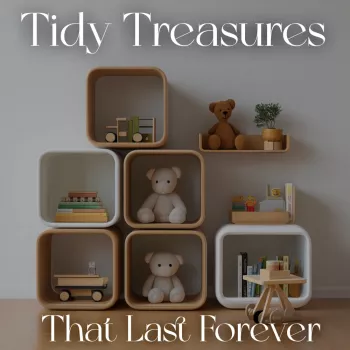
A short weekly reset checklist keeps your system stable without the pressure of a full overhaul. A rotation tracker prevents “where did that go?” moments and helps ensure rotated toys return as complete sets. If you want a ready-to-use toolkit, the Tidy Treasures That Last Forever printable toy organization guide is designed to make labeling, container limits, and weekly resets easy to maintain.
Toy rotations that feel new without buying more
Getting kids to maintain it: independence without battles
Common sticking points and quick fixes
In small spaces, go vertical with shelves, use door hooks for dress-up, and store rotation bins under beds. After birthdays and holidays, pre-plan a “swap day” where new items come in only when container limits are respected. For a hands-on, contained activity that stores neatly as a set, the DIY Wooden Bloom Box 3D Puzzle Kit can be a great rotation-friendly option.
Printable guide to keep the system consistent
FAQ
How many toys should be out at once?
For many families, 6–10 activities for toddlers and 10–15 for preschoolers is a workable range, adjusted for space. The best measure is whether your child can choose independently and put items away without the whole room exploding; rotate the rest.
What’s the easiest way to start organizing toys when time is limited?
Pick three categories, set one bin per category, add labels, and do a 10-minute reset for a few days in a row. Once that feels easy, expand category by category using a checklist so you don’t overcomplicate it.
How can labels work for kids who can’t read yet?
Use picture + word labels and keep placements consistent so your child learns by matching. For toddlers, real photos of the actual toys on the label can make cleanup feel like a simple sorting game.










Leave a comment